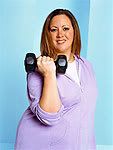
No matter what condition you're in, you can get in better shape without it hurting. If you're starting from absolute zero, you're overweight, you're sedentary, and you haven't worked out in years, expect to start slowly. Exercise does not have to be hard in order for it to be beneficial. Start by working out 2 days a week for 20 to 30 minutes. Use light dumbbells, such as 2lbs, for your weight training. Even though the weight may feel light, start with those. It will keep you from getting too sore and feeling too tired the first couple of times. After the first week, increase the weight to 3lbs. Stick with this for another week or two. Then increase it to 4 or 5 lb dumbbells.
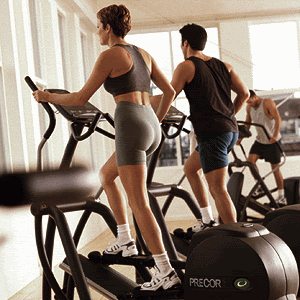
For your cardio, start by walking at a comfortable pace on a treadmill or outside for 10 minutes. Then each week increase your time by 5 minutes. Keep your pace comfortable. You should be able to work your way up to 20 minutes in 2 to 3 weeks.
The secret to exercise is to not make it so hard that you don't enjoy it. It takes time to get your body in shape. Each time you work out you will feel a little bit stronger and have more stamina.
If you're losing your enthusiasm to exercise or finding you're not sticking with it, it's probably time for a change. These 3 signs may be why you're struggling.
Are you bored with your workouts?
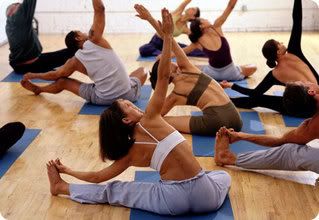
It's easy to get bored if you stick with the same routine for too long. Start adding variety to your program.
Are you not seeing results from your workouts?
If you're doing the same activity all the time, you're more likely to plateau and stop seeing results. Again, vary your routine.
Are you tired and sore from your workouts?
Exercise should give you energy, not leave you feeling rundown. You could be over training. Take a couple days off and let your body rest.
According to a new study in the Archives of Internal Medicine, women who exercised while trying to quit smoking were twice as likely to remain smoke-free and gained about half the weight of those who did not exercise. 280 women participated in this study. Half of them participated in a counseling program on quitting smoking. The other half participated in the same program AND exercised 3 days a week. The exercise sessions included 30 to 40 minutes of brisk cardio. The group that exercised said they felt better mentally and physically which helped to make it easier not to smoke. They also gained less weight after they quit smoking.
New research from Duke University says if you spend time around people who have good self-control, then you can expect your own self-control to be good.
And spending time with people who have less self-control will influence you negatively. There is a direct effect of your friend's behavior on your behavior.
In fact, this applies to not only friends, but the people you're around a lot such as coworkers, husband, wife, boyfriend or girlfriend. Surrounding yourself with motivated, healthy people, improves your odds of staying in control.
If you want to help your spouse or partner to lose weight, set a good example by eating healthy and exercising. Odds are they will start doing the same.
Many people think that the more cardio you do, the more weight you lose. Cardio does make a difference, but you need a combination of aerobic exercise AND strength training to burn fat and keep it off. Strength training helps by mainta ining your muscle mass. You need muscle mass for a strong metabolism and for keeping your metabolism fast. That doesn't mean you have to look like a bodybuilder, but you at least have to maintain or better yet, increase your lean muscle mass. So a combination of aerobic exercise and strength training is the best program for losing weight.
Ideally, you should do strength
training 2 days a week and
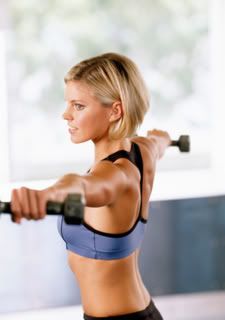 cardio 3-4 days a week.